Glyphs - Specimen Book Initial Research
- Dec 6, 2020
- 5 min read
Brief
The last stage requires you to present your new sign-set of glyphs in the form of a type specimen book.
Specimen books were creative vehicles for a printer/designer to demonstrate their skills in composition, presswork and binding. As books, they were well- designed objects and contained prelims and end matter, information about the typeface, showing complete alphabets (both upper- and lowercase) of the typeface at different proportions and sizes.
Research

From quite early on I knew I wanted to create a different spin on a specimen book. This whole module was about typologies (collections). From early on I knew that I wanted to incorporate something that I collect which are postcards. I considered using them early on in my summer project. I find they are important to me because they are small pieces of affordable art that I can have surrounding me. Which I find influential for inspiration. I wanted to make a series of postcards that helped to show my new language that I have created. So to start off my research I looked at the post cards I had collected.

This post card though it is quite comical it is inspiring in how the post card is laid out. And using a simple ink and pen drawing to create this sketchy feel. I think because my typeface is more structured I am going to avoid the sketch feel but the simple use of colours and grid I will take on. I then moved on at looking at some specimen books and see some real world examples. So I could consider how others have shown their typeface.
Mabry Specimen Book - Colophon Foundry


This was an example of a printed specimen book by the type foundry Colophon. The simplicity of the book with the use of only three colours helps to emphasis the font. I like this specimen book because it seems interesting and unique. This was one of the specimen books that I found the most interesting many other specimen books just seemed a little bit boring. Because they had been laid for technicality and to clearly show each different type of weight and font. However because my typeface did not have any variation in weight I wanted to be more playful.
Workshop
At this stage I had a workshop where we created our own mock up specimen book linking back to the type we created in a previous workshop which helped us to understand the construction of type.



This workshop was useful because it made me consider placement and how things can relate to each other on a page. It also gave me confidence because it showed me how quickly I could create a specimen book on indesign and use different paper to create a more interesting effect. After creating this book I moved onto creating my own book I started off by doing a lot of secondary research.
Secondary Research
Type and specimen books - Rosetta Type Foundry

Rosetta Type Foundry created a series of specimen books which were awarded the European Design Awards 2020. Each specimen book created used simple colour scheme and illustration or pattern to evoke the meaning behind each type. This was another example of an interesting specimen book.
Sharktooth - Mark Simonson

This graphic on Mark Simonson's website. Is something I could do to create my postcards is use an illustration or graphic to help back up my glyphs.
Alex Walker Article - Its Nice That

I looked at an article on Its Nice That about Sandberg Institute's graduate (Alex Walker) work. He used the simple of Risograph printing to create a really interesting and alternative layout showing his research for a project he had to do at university. This way of layout is something I really want aspire to create either in this project of future projects.
Tuan Quoc Pham Article - Its Nice That

I also read another article about a designer who create postcards for exhibition. It was interesting to see a designers take on a postcard.
Box of Feelings - MADO
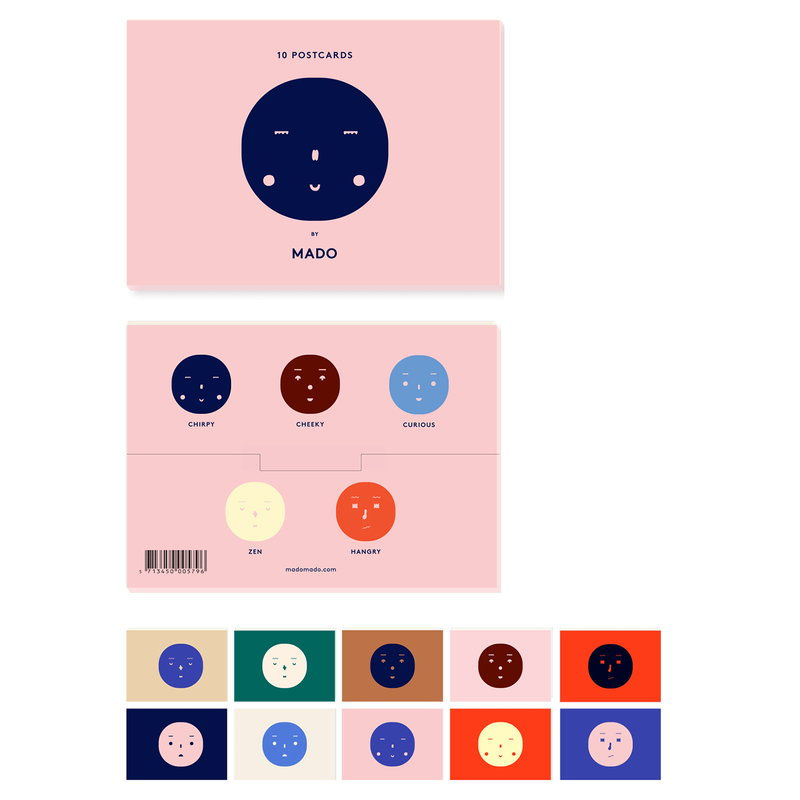
MADO is a Nordic design shop and each collection they sell a series of postcards. In this series of postcards each one has face with a different emotion this is something I want to do with my post cards. Each post card is a simple glyph and the sound.
Things I have Learned in my Life So Far - Stefan Saigmeister

Things I have learned in my life so far is Stefan Saigmeister's manifesto for design. I liked the idea of having a slip case (like the ones I created in a previous bookbinding Workshop.) He also used interesting cutouts to help relate that everything inside the case is his thoughts. Cut outs could be something I incorporate into my design.
Initial Ideas
From the research I did I noted down some initial ideas in my notebook.


I then very quickly went onto the computer which was a mistake I should have slowed down and made a few more sketches of what the layout could be and my colour scheme. I spent a long time struggling to create something I was happy with above are some initial designs. My designs just felt very boring and simple I wanted to make something simple but also exciting. Therefore, I was very quickly stuck at dead end so I did some thing else for a while and a new idea came to me.
New Concept
My new concept is 'Pattern Fragments' when in the Pitt Rivers museum the first object that inspired to make my glyphs out of different patterns from the museum. Was a broken piece of pottery (or fragment) which had a pattern on it. I never ended up using it because the photo I took was not good enough. But it was a good starting point. So I wanted to create this design with that in mind. I created a mood board on Pinterest to get my idea across.

Restaurant ISSHO - Studio DutchScot

This Design created by Studio DutchScot was designed to evoke the togetherness of Japanese and British cuisine. Using the gold lines to describe idea of fragments fixed together. This was a very important thing that inspired my final design.
Development
I then moved on to sketching out my idea before going onto the computer so I could get a clear idea of what I want to say.


My idea at this point was to create a poster that was a series of paper fragments which had my letters on them. Each fragment worked on their own but joined together they created a poster. Each fragment was a piece in a puzzle.
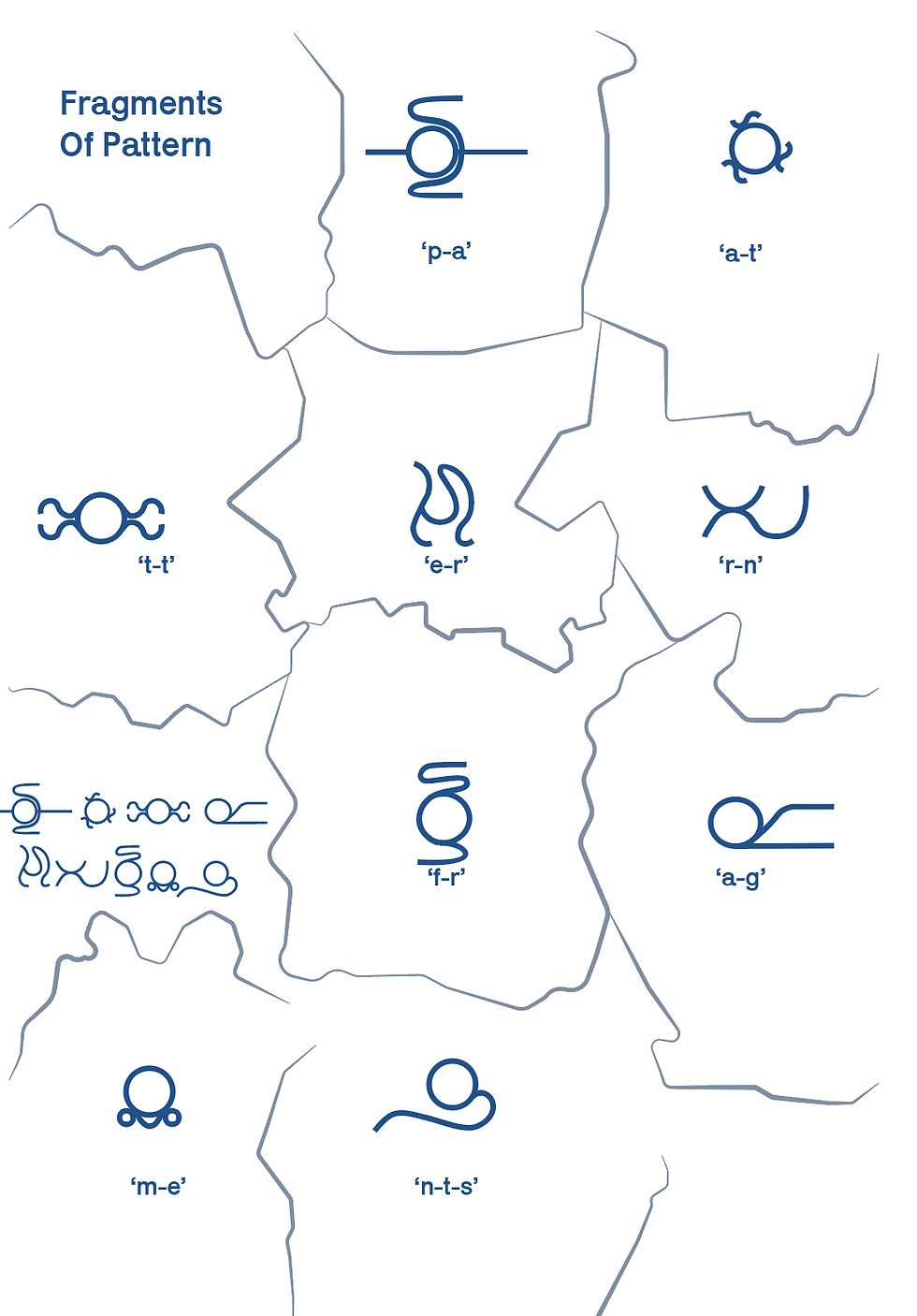
This was my first Initial design of the fragments the layout was already fairly simple. For the layout I was inspired by botanical drawings and how each flower is evenly laid out with a label underneath. This idea came from a power point I was given by my lecturer. In the power point it stated:
Aesthetics; the most enduring motivation behind botanical art, despite its scientific origins, has been aesthetics. Therefore, make your specimen book beautiful, dramatic – make it a spectacle in itself.

I also decided to add pattern for the back of the poster in order to show how the glyphs could look together. I first just created varying rows of my type which looked quite Hieroglyphic.

To create a more random pattern I used the skills I learnt in a previous workshop where I learnt how to create patterns in Illustrator.

Sounds for the Glyphs
At this stage I also created sounds for each glyph. I made so that when said together glyphs would say 'Pattern Fragments'.
'PA'

'AT'

'TT'

'ER'

'RN'

'FR'

'AG'

'ME'

'NTS'


Comments